
The development of leptonic accelerators echoes strong physics themes such as future colliders for high-energy physics or light sources to probe matter, based on synchrotron radiation, free electron laser, interaction with a laser or energy harvesting with an ERL. The need for high luminosity or high brightness requires specific R&D to improve beam quality (reducing emittance) and charge (increasing current) as well as the manipulation and control of nano-beams at the collision point. Increasing beam density will also increase collective effects related to the interaction of the beam with the electromagnetic field induced by the beam, as well as dynamic vacuum effects (increased residual pressure caused by electron-cloud or photo-electrons generated by the interaction of synchrotron radiation with the walls).
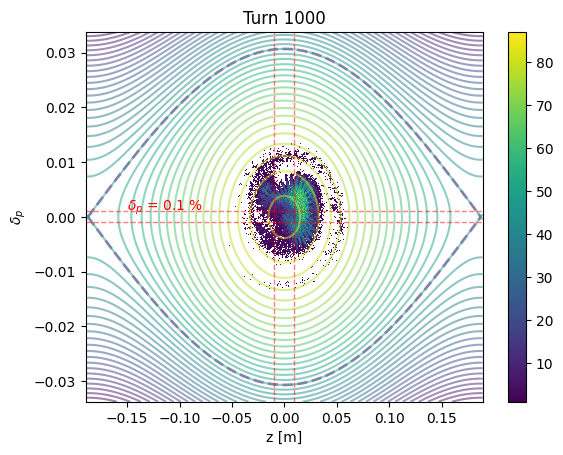
Simulations with the pyHeadTail code of the longitudinal tracking of electrons in the CERN FCC-ee booster. This study, carried out after 1000 injection revolutions at an energy of 20 GeV for a bunch of 2.43e10 electrons, simulates the wake created by a 50 mm diameter stainless steel vacuum tube (credits: A. Ghribi).