
The technological field of current and future hadronic accelerators requires continuous research and development efforts in order to advance science and meet new challenges in terms of efficiency, beam loss control, reliability, as well as reducing financial and energy costs. Understanding the beam must be improved with the main objective of reducing particle losses from increasingly powerful beams: this is achieved mainly through accurate numerical models, optimization of beam control via artificial intelligence, high-performance diagnostics, RF simulations and fault compensation. This work is accompanied by technological developments for improvement and innovation on the chain of components that make up these accelerators, in particular on radiofrequency quadrupoles (RFQ) and superconducting accelerator cavities (SRF) to improve acceleration gradients and reduce energy consumption.
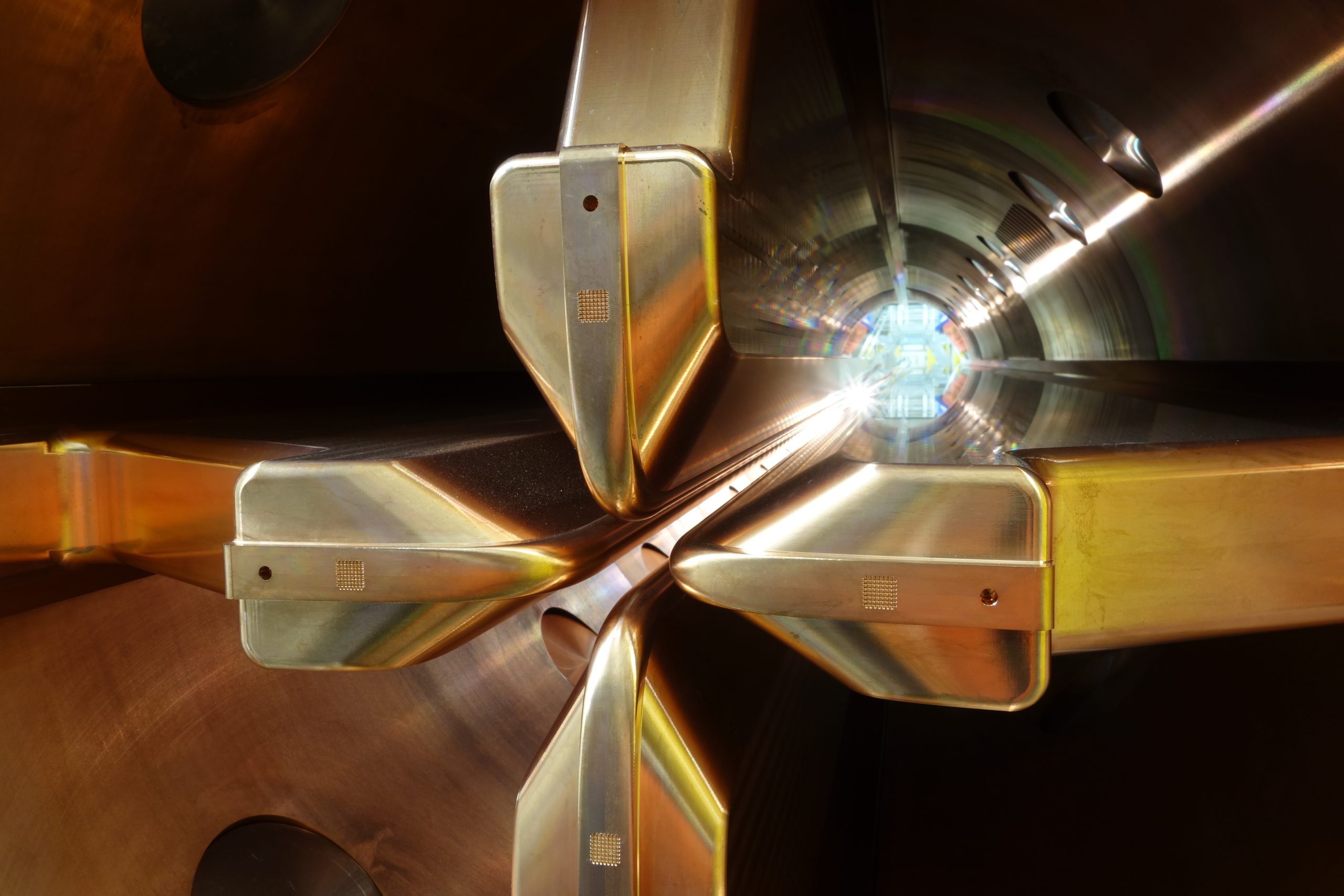
Internal view of the SPIRAL2 4-vane radiofrequency quadrupole (RFQ) at GANIL for beam acceleration and temporal bunching (credits: R. Ferdinand).